
On May 20, 2026, President Kiss (pronounced “Quiche”) sent a video message to Union faculty and staff, informing them that the college will face a larger budget deficit next academic year. The college is responding by making compensation changes, staffing adjustments, and focusing on longer-term enrollment initiatives. Concordiensis obtained the video from a YouTube link posted on Union College’s YikYak and spoke to President Kiss about its contents.
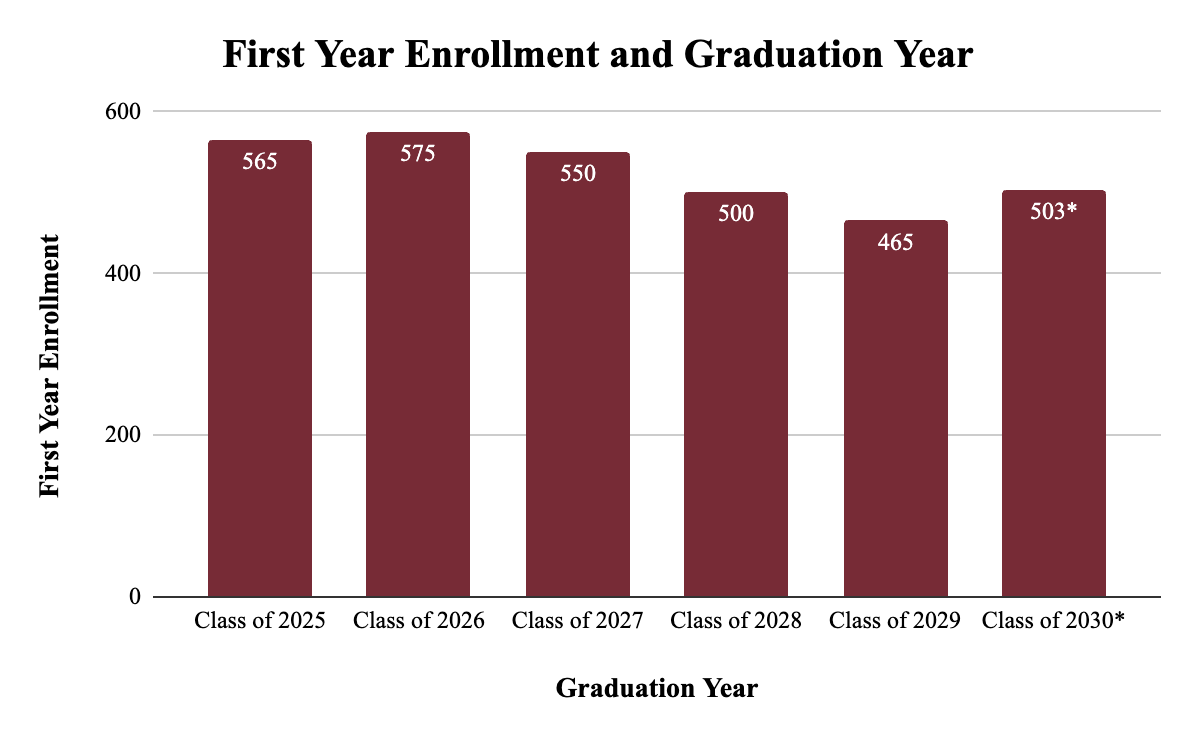
In the video, Kiss initially projected the incoming class to be 510 students. About two weeks later, she told the Concordiensis that the expected class size had decreased to 503 students. She attributed the change to what colleges refer to as “summer melt,” the period between a student’s college commitment and the start of classes, when some students change their plans. “This happens for any number of reasons: some may decide to defer a year, and others may receive a late offer from a school that had originally wait-listed them.”
“We have had a number of deferrals, so currently have 503 first-year students enrolled, but our rate of ‘melt’ so far this year is less than in recent years,” Kiss told Concordiensis. “We’ll be working hard to retain all our currently enrolled students, but we are also building our budget on a lower number to be prudent.”
This projection is an improvement from the 465 first-year students enrolled this academic year. However, in the video, Kiss said that the 2027 fiscal year (FY) budget deficit will be larger than the 2026 budget (this academic year’s). Kiss explained that “This projection is because our current graduating class is larger and received less financial aid. So even with a larger incoming first-year class, our overall student number will go down a bit.”
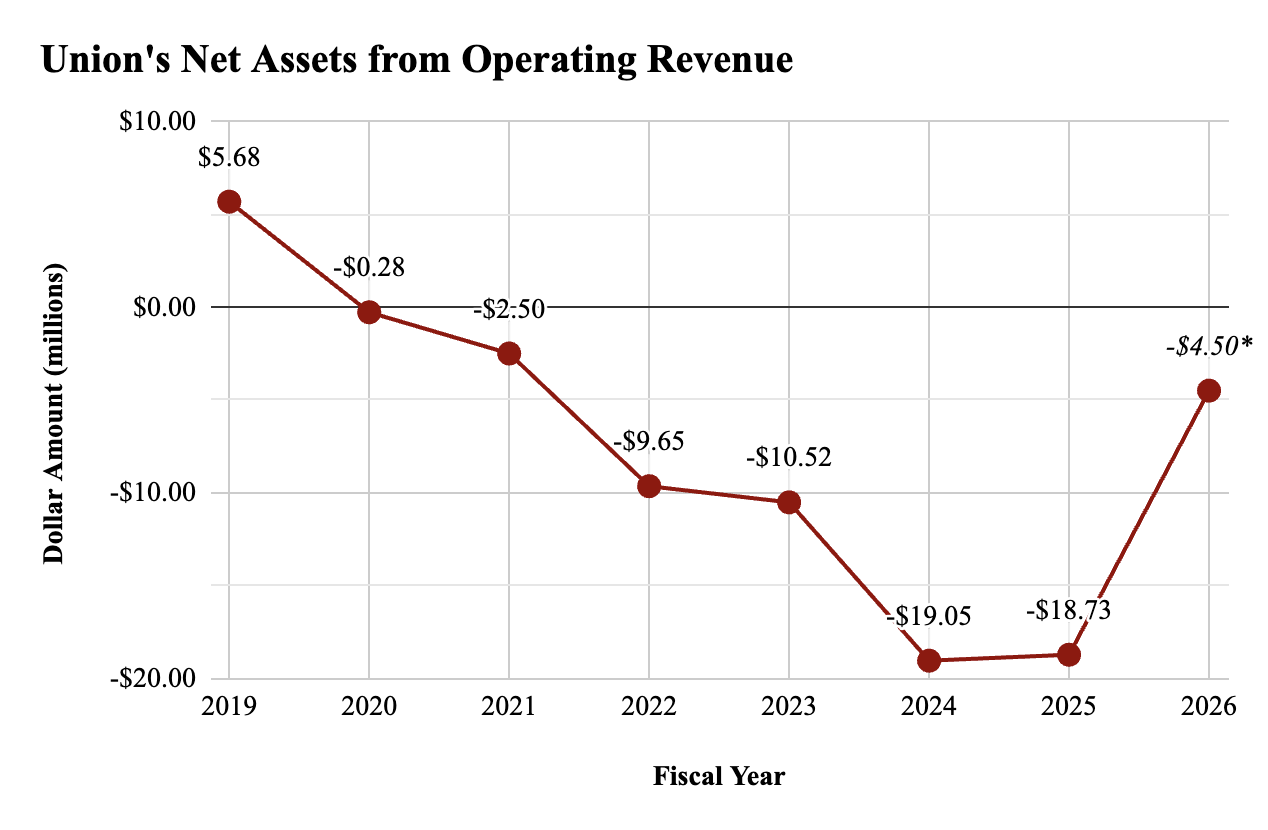
Kiss did not provide Concordiensis with a projected dollar amount for the FY2027 deficit, but audited financial statements show that the college has experienced increasingly large operating deficits in recent years. Concordiensis analyzed Union College’s financial statements for fiscal years 2019 through 2025 and found that the college’s net operating revenue has deteriorated over that period. For FY2019 (the 2018-19 academic year), the college reported an operating surplus of $5.68 million. Six academic years later (the 2024-25 academic year), the college reported an operating deficit of $18.73 million.
In November 2025, Kiss emailed the campus community to say that the college entered FY2026 with an expected budget deficit of approximately $12 million, and that additional $5.6 million in endowment withdrawals and compensation-related changes reduced the projected shortfall to approximately $4.5 million. It’s unclear what the projected FY2027 budget deficit is at this time.
In order to reduce next year’s deficit, Kiss said the Board of Trustees has voted to temporarily reduce retirement contributions from 8% to 4% and to give employees a 2% year-end bonus. Kiss emphasized that this is intended as a temporary reduction and will be reviewed every academic year, with the goal of raising it back to 8%. This follows a reduction in the retirement contribution from 11% to 8% this academic year. Kiss told Concordiensis that she does not anticipate any layoffs within the next year.
Additionally, Concordiensis asked Kiss about how the Early Retirement Incentive Program (ERIP) would impact the budget and campus operations. Kiss said that more faculty and staff than anticipated have taken the ERIP offer, but this provides opportunities for the college to save money when hiring new employees.
“On the staff side, when someone leaves or retires, we look to see whether we might have an opportunity to restructure a unit rather than replace that position,” Kiss said. “In the case of faculty, most of whom will be retiring in June 2027, we will see savings when we replace a retiring full professor with an assistant professor or, in some cases, a full-time Lecturer.”
Kiss said these retirements may have a temporary impact on the student experience, but the college is committed to maintaining the quality of the student experience. “We are looking carefully at each position to figure out how we sustain operations and protect the student experience,” Kiss explained.
All of this comes as the college plans to achieve a balanced budget over the next few fiscal years. Kiss said that the college intends to implement recommendations from its Art & Science study and reduce overall spending.
“The main factor is that we expect to achieve enrollment and revenue growth by implementing the results and recommendations of our Art & Science study, which is helping us identify how Union can make itself stand out and be more attractive to prospective students,” Kiss explained. “And second, we will continue to reduce costs where possible. The Trustees have agreed to allow the College to cover deficits through external financing in order to give us time to implement the Art & Science recommendations.”
* The data point for FY2026 comes from an email from President Kiss sent in November 2025, and not audited financial statements. Financial statements for FY2026 are unavailable at this time.