
With only a couple of weeks until class registration for next term opens, spring is the perfect opportunity for students to fulfill a GenEd or grab an extra credit with an intriguing science class. Read below for exciting intro-level courses from astronomy to environmental studies that anyone can enjoy!
AST-050: The Solar System w/ Lab (M, W 3:05 – 4:45 PM)
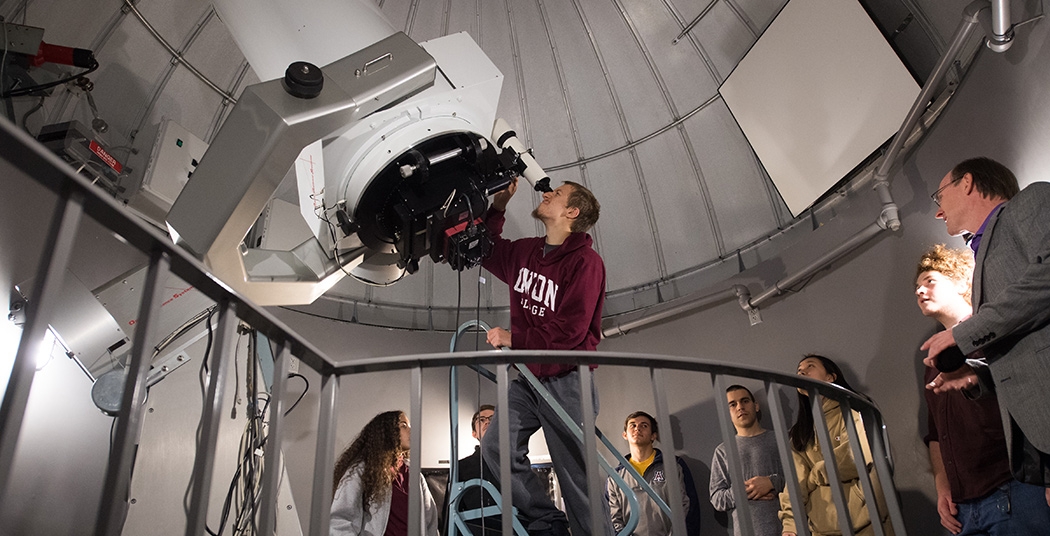
An introductory but detailed discussion of the solar system with special emphasis on the application of physics and the measurement of fundamental properties. Topics include the contents of the solar system (earth, moon, sun, planets, asteroids, comets), formation of the solar system, evolutionary processes (cratering, volcanism, tidal effects), extrasolar planetary systems, and possibilities of life on other planets. Labs will be performed in which students learn how to find and observe the planets and measure fundamental properties. No background in mathematics or physics required.
Fulfills GenEd Requirement: GNPS
CSC-084: Interactive Fiction Workshop (M, W 3:05 – 4:45 PM)
Interactive fiction is storytelling that uses technology to create an interactive ‘reading’ experience, requiring the reader to make choices that influence the plot. In this course, students will read, critique, and create interactive fiction. You’ll develop your storytelling skills, and along the way, you’ll learn some programming concepts. This course is open to anyone who has taken a 100-level course in English. No previous CS experience is necessary.
Fulfills GenEd Requirements: JCAD, JLIT, and JETS
MTH-076: Mathematics and Democracy (MWF 10:30 – 11:35 AM)
In this course, we will assess democracy through multiple perspectives, most centrally through mathematics. In particular, we will ask ourselves essential questions such as: How can we measure and quantify democracy? How can quantitative methods enable us to analyze the concepts of fairness and bias, and also, what are their limitations? How can (and should) math play a vital role in upholding the essential democratic tenets of access, participation, and human rights? Throughout the course, we will use mathematical notation and terminology to represent real-world issues. Not open to students who have passed (or have AP credit for) a college calculus course.
Fulfills GenEd Requirement: JDQR
PSY-100: Intro to Psychology (MWF 10:30 – 11:35 AM or T, TH 10:55 – 12:40 PM)
Learn about the activities and experiences of the human being, including personality and its development, motives, learning and intelligence, and behavior in conflict.
Fulfills GenEd Requirement: JSPE
ENS-100: Intro to Environmental Studies w/Lab (MWF 9:15 – 10:20 AM)
An introduction to environmental studies from a scientific, policy, and engineering perspective. This course covers human-environment interactions, with a focus on the impacts of human activities on natural systems such as climate, air, water, and species diversity and the ensuing environmental injustice. The course discusses sustainable solutions for how we can build systems that will support billions of humans and the natural world. Fieldwork during lab periods involves the investigation of local environmental problems and solutions. This course is intended for first- and second-year Environmental Science and Environmental Policy majors, but it is open to all students.
Fulfills GenEd Requirement: GNPS
ECO-134: Data Visualization (T, Th 1:55 – 3:40 PM)
The digital world we live in generates vast amounts of data. This data has the potential to help us understand the world and make better decisions. This course is about representing data using the visual domain. We learn how to turn gigabytes of numbers into pictures and interactive displays. We will use the visual domain not only for communicating insights but also as a means of analysis. We will learn about data structures (how to connect to data), data aggregation (how to summarize data), and principles of design (how humans consume visual content). We will apply these concepts to business and economic data, including sales, financial performance, pricing, etc. The emphasis is on hands-on exercises and creation of new visualizations using data visualization software Tableau.
Fulfills GenEd Requirement: JDQR